
Where Ads Get Made: New Cities, Fewer Shoots, and Celebrities Everywhere
The advertising production landscape looks very different than it did five years ago. Production volume is down more than 20% nationally since 2019, new regional markets are gaining ground, and brands are rethinking where and how they produce ads and use talent.
But there’s more to the story. The industry is evolving to meet new platforms, production demands, and the challenge of reaching increasingly fragmented audiences.
XR has been tracking these geographic and economic shifts in U.S. advertising production, revealing where brands and agencies are shooting more, where production is declining, which markets are gaining ground, and what talent is being paid. For the first time, we’re bringing that data together in our new report: “XR: Where Ads Get Made.”
California Still Anchors the Industry and Has Room to Grow
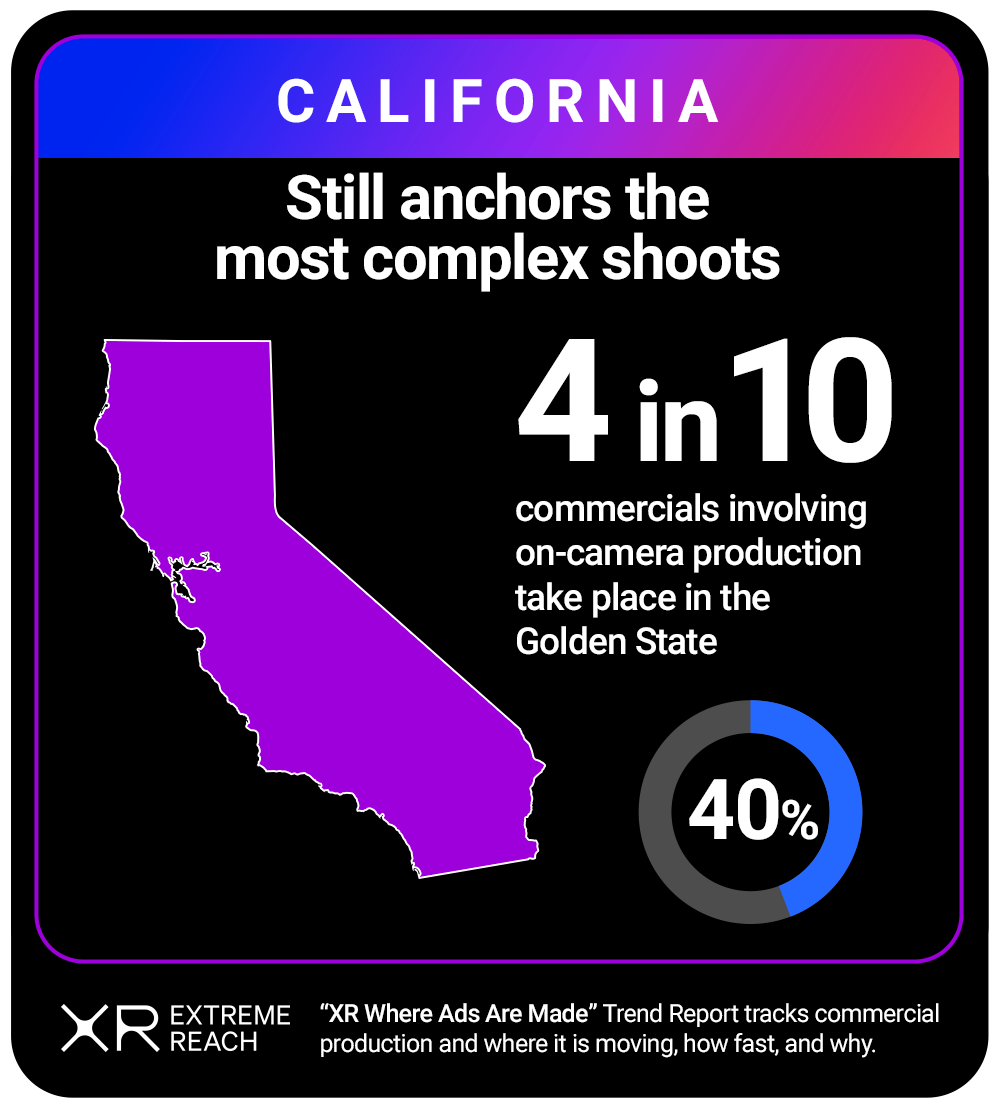
Despite the negative (but mostly true) news about film and TV series leaving California for international markets, the Golden State remains the center of the U.S. ad production universe with 42% market share for all U.S. advertising productions.
Why? It has the most robust production infrastructure, including world-class studios and post-production facilities, and it’s still home to much of the industry’s most experienced crew and celebrity talent. It also remains a place where many agencies prefer to shoot, when they can afford to.
But California’s dominance isn’t guaranteed. Other regions are growing their production volume and attracting brands and agencies with lower labor costs and aggressive incentives.
“California and Los Angeles have held steady even as production has declined nationwide,” said Frank DeVito, President and COO, XR Pay. “The talent, both in front of and behind the camera, is already here, and they’ve maintained a presence without commercial-specific incentives. That gives the region a strong foundation for growth if new incentives are taken seriously and become available to brands and agencies.”
Texas, Florida, and Georgia are Rising
While California holds strong, states like Texas, Florida, and Georgia are seeing real, year-over-year growth. This isn't a temporary or incentive-only story; it's being driven by a combination of factors reinforcing each other:
- Economic incentives that make these states financially attractive for productions
- Competitive labor rates compared to traditional coastal hubs
- New production infrastructure and studio facilities that give these markets the physical capacity to handle bigger, more complex shoots
- Experienced local crews who can now support full commercial production, a critical shift from years past, when talent depth outside California and New York was a limiting factor
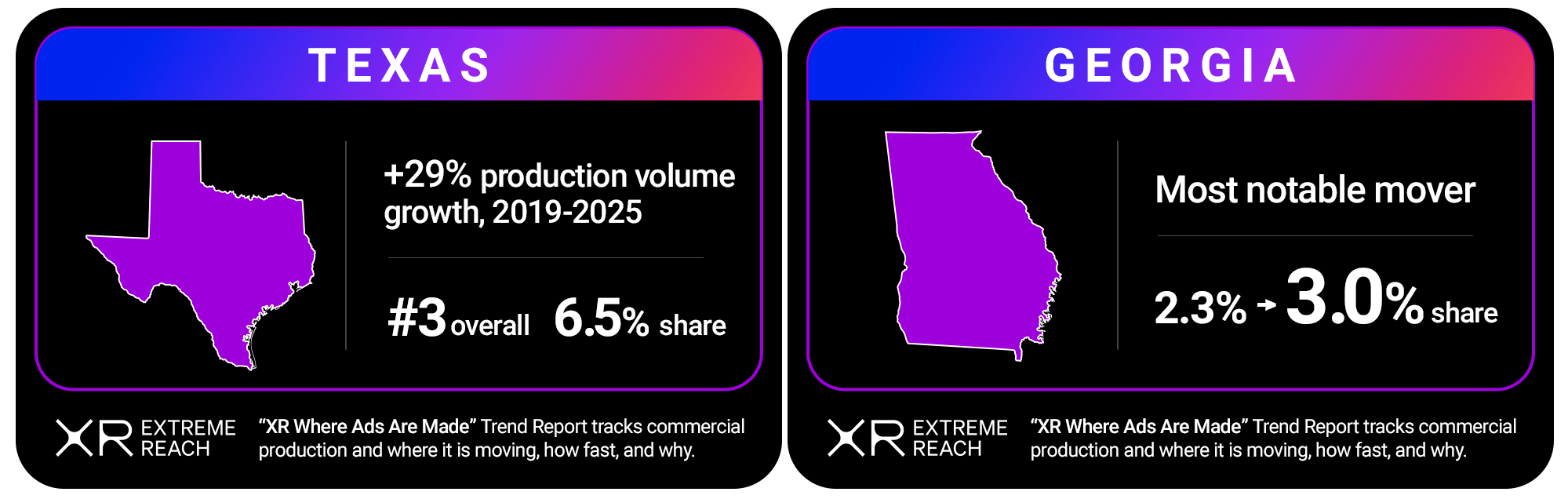
Texas leads the emerging production hubs with a 6.5% share, followed closely by Florida at 5.9%, with both holding steady through the first half of 2026. Georgia is the one to watch, climbing from 2.3% to 3.0%. Missouri and Ohio are also quietly gaining ground, posting consistent multi-year growth.
As more production work moves beyond the traditional coastal hubs, we expect this trend to continue. The infrastructure and crew base being built in these markets isn't going away, which means their growth is likely structural rather than cyclical.
The Celebrity Ad Boom Is Still Booming
On the creative side, one of the clearest trends is the sheer amount of celebrity and talent pay in advertising, which is at an all-time high. More brands and agencies are turning to famous faces to anchor their campaigns, and this isn't confined to the annual Super Bowl spectacle anymore. Celebrity-led advertising is now a year-round phenomenon, showing up across nearly every major advertising category.
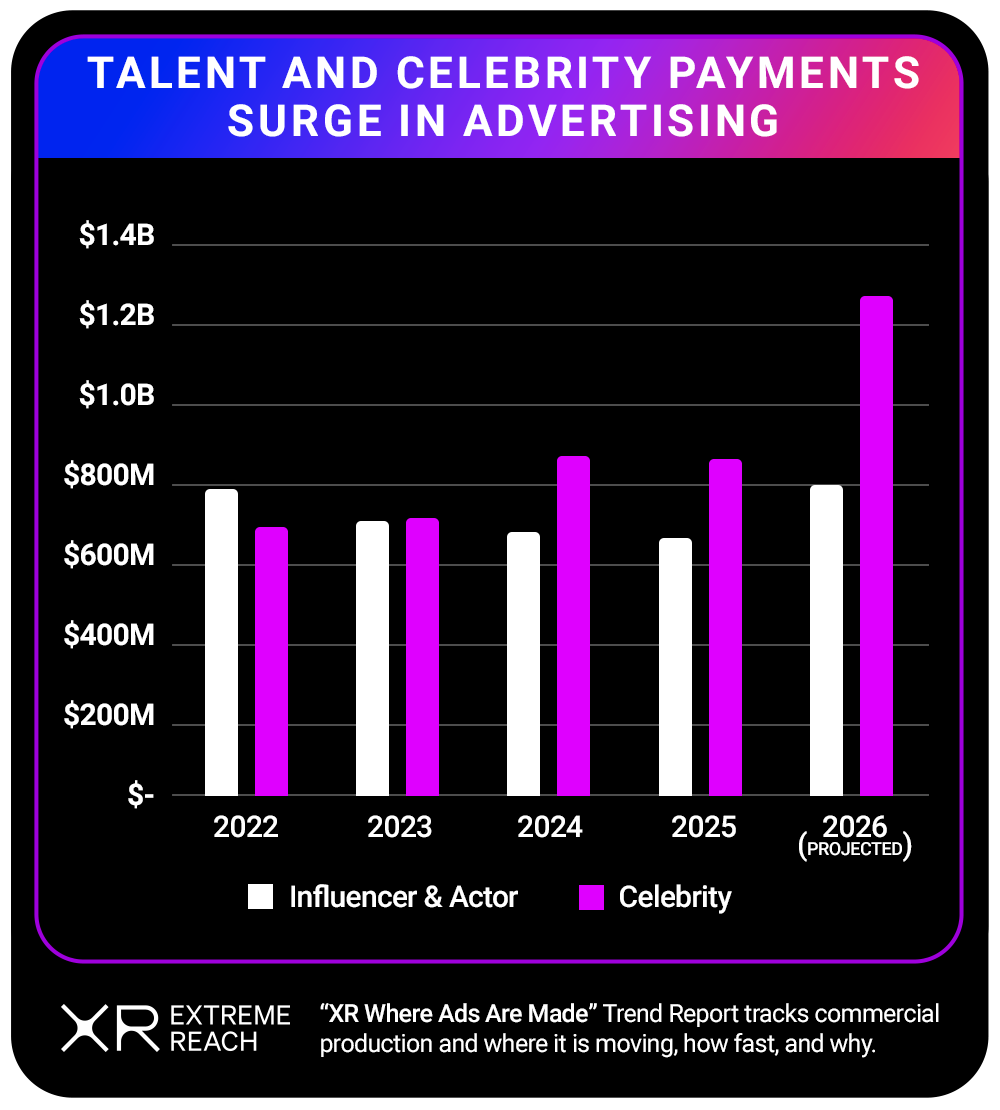
This shift reflects a broader bet by marketers: in a crowded and increasingly fragmented media environment, star power is one of the most reliable ways to cut through and anchor a campaign's identity.
Doing More with Less: The Rise of Content Versions
Perhaps the most operationally significant shift is happening well after production wraps. Brands and agencies are getting more advertising content out of every production they do. A single shoot now routinely generates hundreds of versions of an ad. They are cut down, reformatted, and adapted to support the growing number of CTV, social, and digital platforms brands need to feed.
The result is a bit of a paradox: overall production volume is down, but brands and agencies are extracting significantly more mileage and value out of every shoot they do. Fewer productions aren't necessarily a sign of a shrinking industry; they may simply reflect a more efficient one.
The Bigger Picture
Taken together, these trends describe an industry in transition. Production is decentralizing geographically, even as California retains its central role. Celebrity talent is playing a bigger and more constant role in campaigns. And the economics of production itself are shifting toward efficiency, with teams squeezing more usable content out of every dollar spent on set.
For brands, agencies, and production companies alike, the questions this raises are clear: Where should we be shooting? Who should be fronting our campaigns? And how do we build an operational infrastructure that’s engineered from day one to deliver more content across every platform we need to fill?
XR’s data comes directly from contractual, production, and payment activity across the XR Pay and Ads platforms. It reflects actual commercial production volume and talent payments, providing a unique view into where ads are being made and how those patterns are changing.
Who We Roll With


